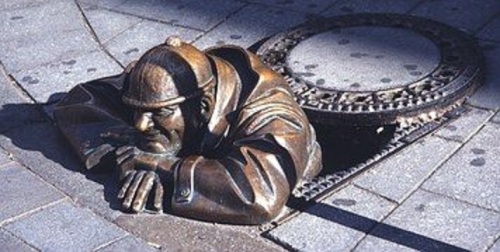
Let Your Creativity Ripen

Being an artist means: not numbering and counting, but ripening like a tree, which doesn’t force its sap, and stands confidently in the storms of spring, not afraid that afterward summer may not come. —Rainer Maria Rilke

10 Ways to Amuse Your Muse*

  1. Write something silly, like a haiku about your boss’s tie or the dialogue your dog would have with the cat if he could talk.
  2. Make something silly—knit an envelope or create a collage out of pictures of toes.
  3. Watch this video of a typing monkey.
  4. Freewrite about something silly. Use this prompt: When he appears in my life, the closet monster always takes something from me, but I have to admit, he never…
  5. Make a snack that reflects your mood. Like smiley-face pancakes. Or a Ready-to-Erupt volcano Sundae.
  6. Write a list of silly things you would never do. Then do one of them.
  7. Pick the most outlandish thing on your list of silly things you would never do. Write about doing it.
  8. Create a story about a nonsensical image you remember from a dream.
  9. Write a journal entry about your day in a Dr. Seuss-like rhythm. Or tell it as a fairy tale.
  10. Create a character who’s the opposite of you. Then see what this character does when you write about him/her.
  11. Write a story about the two starfish in the picture above.

* plus a bonus Muse-amuser!

Sandbox Challenge #11: A Writing Prompt

Today’s it’s a simple prompt:

These are the things I lost.

Write a poem, essay, story, memory, freewrite, description…whatever this sentence evokes in you. If you like, change it to “These are the things she/he lost.”

I’d love to see your creations in the comment section if you feel like sharing.

Defuse Your Inner Critic With This Explosive Visualization

When I was a kid, we had a computer at home long before most people did because my father was a scientist. (Actually, I first experienced a computer that took up an entire small room in my dad’s lab. My sister and I learned to play blackjack on it as tiny girls when my mother dropped us off to hang out with Dad while she ran errands. But I digress.)

By the time we had a computer at home, I was a teenager and focused on other things, like my social life. But my little brother taught himself programming, and developed a few rudimentary games. One of them sticks in my memory, because I found it amusing. He created a program that allowed you to simulate a person you hated by choosing basic characteristics like sex and hair color. Once you’d constructed your nemesis, you could make him or her explode. That was the entire game.

Thinking about that game of my brother’s always makes me smile. It’s such a perfect illustration of an elementary school boy’s desire for emotional gratification. I remember the glee with which he demonstrated it to me, creating his schoolyard enemy and then eradicating him.

I thought about my brother’s game again today while contemplating the negative inner voices that keep so many of us from being the fully creative individuals we’re meant to be. Wouldn’t it be great if we could blow those eternal critics to smithereens once and for all? Detonate the Inner Perfectionist who tells us our creations aren’t good enough? Blast away the Mean-spirited Fault-Finder who tells us we aren’t good enough? Destroy all the voices insisting we’re not really writers and, by the way, our work stinks?

I decided to create my own version of the exploding enemy game, one that writers can visualize any time those nasty voices start their negative humming in our heads. The explosion you create in this visualization is gentler than in my brother’s game, but feel free to modify it in any way that works for you:

Close your eyes.

Relax with your hands in your lap, palms facing up.

Take three deep breaths. As you exhale, relax the muscles in your face, your neck, your shoulders. Feel the tension dripping away, all the way down your body and through the floor.

Now breathe normally and listen to the inner voice that’s telling you something negative. Really hear what he or she is saying. If there’s more than one voice or one message, just focus on the loudest one—you can go back and do the visualization again for each voice, if necessary.

As you listen to the voice and its message, imagine it as a character. Visualize how this inner critic looks and watch him as he yells, sneers or whispers his negative message. Take your time with this. The voice may come to life as a person, a monster, an object or anything else you can picture. Imagine the details of your critic’s face, body, clothes and gestures.

Once you have a clear image of your inner critic as a solid character spewing his negative message at you, imagine he’s suddenly being pulled a couple of feet up into the air by his shoulders. He’s still berating you, but his legs are moving helplessly, and it makes him look slightly comical.

Against his will, your inner critic is gradually pulled further and further up. It’s as if he’s attached to invisible marionette strings and the puppeteer is drawing him away from you.

As he floats upward, your inner critic’s voice becomes fainter and fainter…

You watch while he becomes increasingly smaller. Once he’s transformed into a tiny, ineffectual cartoon high in the air, he breaks up into a million pieces and dissolves into the sky.

Now that he’s gone, you look down again. You realize you’re standing in a beautiful meadow. You can feel the warmth of the sun on your face, and the grass is soft underneath your bare feet. You breathe in the scent of flowers and inhale the calming tranquility of the peaceful meadow.

Now open your eyes and begin writing.

Repeat this visualization every time an inner critic appears and tries to slow down or prevent the creativity you truly deserve to express.

Poetic Inspiration

On her inspiring new site, A Bowl of Random Words, Mother Sparrow pulls words from a bowl and posts them, inviting readers to create poems from five seemingly unconnected things. Give it a whirl—I tried it and was pleased with the poem that resulted!

A Great Source for Photo Prompts

Roka Walsh posts a compelling new photo every day on her wonderful blog Stories Without Words, and invites readers to “tell a story…pen a poem…write an essay…sing a song…create a title or caption” inspired by the image. She also offers interviews with the photographers and writers who contribute their work to round out her creatively stimulating blog. Check it out, scroll down and find a picture you’re drawn to, then write something inspired!

Another Right Brain/Left Brain Test

Take the Right Brain/Left Brain Test

I can’t vouch for the accuracy of this Right Brain vs. Left Brain Creativity Test, but when I answered the questions, my results seemed correct according to my own self-assessment: 57% Right Brain and 43% Left Brain. (The right hemisphere of the brain is the more creative area, while the left hemisphere is more logical.)

The test also breaks down the results in a number of categories within each hemisphere. Mine showed my dominant left brain style as logical processing, and my primary right brain style as fantasy-oriented. Again, that sounds about right to me.

Try it for a fun break!

Sandbox Challenge #10: Write the First Line of Your Masterpiece

I love writing first sentences. Coming up with something intriguing that will keep a reader reading. I occasionally spend time writing a bunch of them just for fun. Sometimes I’ll go back later and use one to create a longer piece.

Today’s challenge: Write the first sentence of a story, novel, essay or memoir. Write something you think would entice readers to continue reading. Write several if you’d like.

Extra credit: Write the last sentence of a story, novel, essay or memoir. Or write several.

Extra extra credit: Write a pair (or pairs) of first and last lines that could be used for the same piece.

Here are a few of mine:

First Sentences:

One day the Head Engineer changed his mind about the whole gravity thing. (from a published flash fiction story of mine)

My clothes are trying to kill me.

Claude had been reluctantly stealing women’s hearts since he’d turned 16, and now he owned a big collection of them, shoved into the coat closet in his front hall.

If strangers could see the colors of our souls, they wouldn’t look at us as if they’d just found two pieces from separate jigsaw puzzles.

Last Sentences:

He’d always loved a good show. (from the same published story)

Anger rises in me as I think of the ruined sneakers. I’d kept them white for so long.

She lay next to him all night with her eyes on the ceiling, watching a spider making its long trek across the white expanse.

And perhaps, just possibly, the coconut monkey has lost its spiky hair and can no longer puncture the tender fingers of the family’s children with its angry splinters.

If you like, post your sentences in the Tiny Packages section of the Reader’s Sandbox. (Have I mentioned that when you wonderful readers share your creative pieces here it puts a smile on my face? Sometimes I even do a happy dance in front of my computer!)

For more inspiration, check out these links from American Book Review:

100 Best First Lines From Novels

100 Best Last Lines From Novels

And, as always, be sure to have fun while doing this exercise. Play with your words and see where they take you…

Finding Your Voice

I used to live in the desert and drink from the Well of Right Words. One day, I walked until I found an unexpected oasis. Now I sip phrases from succulent fruit and inhale ideas carried by a wind that blows from beyond imagination.

** ** ** ** ** ** ** ** ** ** ** ** ** ** ** ** ** ** ** ** **

People often talk about writers “finding their voice,” as if it’s a lost pet that ran out the door when someone carelessly left it open. We all have a voice, right? We speak. People understand us. But finding your voice as a writer can be a daunting task. You write a short story in the same way you talk, and it falls flat. You create a poem about your lost love and it sounds like a million others you’ve read.

There’s lots of advice out there for tapping into your unique writer’s voice. I just did a Google search on the subject and found many helpful tips: read a lot, imitate writers you admire, write the way you speak, be willing to write badly, don’t censor yourself, write about what you’re passionate about, write about what you’re afraid of…the list goes on.

Though I believe we’re all different and each have our own journey, I want to share my experience here. For me, finding my voice was simply a matter of writing. And writing. Then writing some more. I wrote all the time. I learned to write from my heart. I went where my writing took me, even when it seemed stupid or pulled me in the opposite direction I’d been intending to go. I did massive amounts of freewriting. I took classes and joined workshops. I wrote fiction, poetry, essays, experimental pieces, journal entries and more. I read authors I admired and noticed how they put words together in ways I found interesting.

And then I wrote some more.

Finally, one day, I knew I’d found my voice. I just knew it, the way you always know the most profound things in your life, if you let yourself. I felt it deep inside.

How did you find your voice as a writer? Or what are you doing to find it?

Hang Out on the Page

Sorry to follow my last post with another quote, but I’m having a hectic week and want to offer this small bit of inspiration from Julia Cameron:

Writing goes much better when we don’t work at it so much, when we give ourselves permission to just hang out on the page.

(From today’s entry in The Artist’s Way Every Day.)

Believe in Yourself

Keep away from people who try to belittle your ambitions. Small people always do that, but the really great make you feel that you, too, can become great. —Mark Twain

Next Page »


About Sandy Ackers

Sandy

Writer, dream-chaser, Muse-strangler

To learn more about Sandy, click here: About Sandy

Meet My Muse

Click here to read the post discussing my relationship with my somewhat pesky male muse.

Inspiration in your inbox:

Blog Archive

Total Hits:

wordpress analytics
wordpress analytics

Share This Blog

Bookmark and Share
Add to Technorati Favorites
Writing Blogs - BlogCatalog Blog Directory

COPYRIGHT NOTICE

Copyright © 2009-2010 Sandy Ackers. All rights reserved, with the following exceptions:

Writers retain all rights to any comments, stories or other original work posted on this blog in the comments sections or the Readers' Sandbox.

Many of the photos on this blog are in the public domain. If you'd like to reproduce a photo, contact Sandy Ackers at the email address listed in the ABOUT section of this blog for information on whether the image is under copyright.

Reproducing, copying or distributing the writing on this blog without the express permission of the author is strictly forbidden.

Page copy protected against web site content infringement by Copyscape